If you are evaluating a biodegradable tableware making machine for a new production line or an expansion project, the first decision is not about the machine — it is about what you plan to produce and at what volume. A semi-automatic machine producing 500 kg/day is fundamentally different from a PFA-S1500 producing 850 kg/day, and the stock preparation, forming technology, and drying system all change based on your target product and capacity.
Parason is a biodegradable tableware machine manufacturer with 2,000+ equipment installations across 75+ countries. We supply complete turnkey biodegradable tableware production lines — from pulping to finished product — for capacities ranging from 3 TPD to 100+ TPD. Every machine configuration below comes from our product catalog with real model numbers and verified capacities.
What a Biodegradable Tableware Production Line Includes
A complete biodegradable tableware production line is not just a forming machine. In our experience setting up molded fiber lines across India, Africa, and Southeast Asia, we have seen projects fail because the investor bought only the forming machine and underestimated the stock preparation and drying systems. The full line includes four stages:
- Stock preparation — Pulping raw material (bagasse, bamboo, wheat straw) into fiber slurry
- Forming — Shaping the slurry into plates, bowls, clamshells, or trays using vacuum molds
- Drying — Removing moisture from formed products (hot press or tunnel dryer)
- Trimming and packaging — Edge trimming for clean finish, then stacking and packaging
Each stage must match your target output. If your forming machine output doesn’t match your dryer capacity, you have a bottleneck that kills your entire line efficiency. This is why we supply complete turnkey lines — every section is engineered as a matched system.
Watch: Complete 6 TPD Molded Fiber Production Line
6 TPD fully automatic molded fiber line by Parason at KompoPack India — stock preparation to finished product.
Biodegradable Tableware Machine Types and Specifications
Parason manufactures three types of forming machines for biodegradable tableware, each designed for different product types and production volumes:
Automatic Forming Machine (PFA Series)
The PFA series is the most versatile biodegradable plate making machine in our range. It handles plates, bowls, clamshells, meal trays, and containers using vacuum forming with hot press finishing. Two configurations available — single station and dual hot press:
| Model | Platen Size (mm) | Output (kg/day) | Best For |
|---|---|---|---|
| PFA-S1500 | 1500 × 1500 | 700 to850 | Large-scale tableware — plates, meal trays, clamshells |
| PFA-S1300 | 1300 × 750 | 350 to500 | Mid-scale tableware — bowls, containers |
| PFA-D1000 | 1000 × 950 | 350 to500 (dual hot press) | Thermoformed tableware — smooth finish both sides |
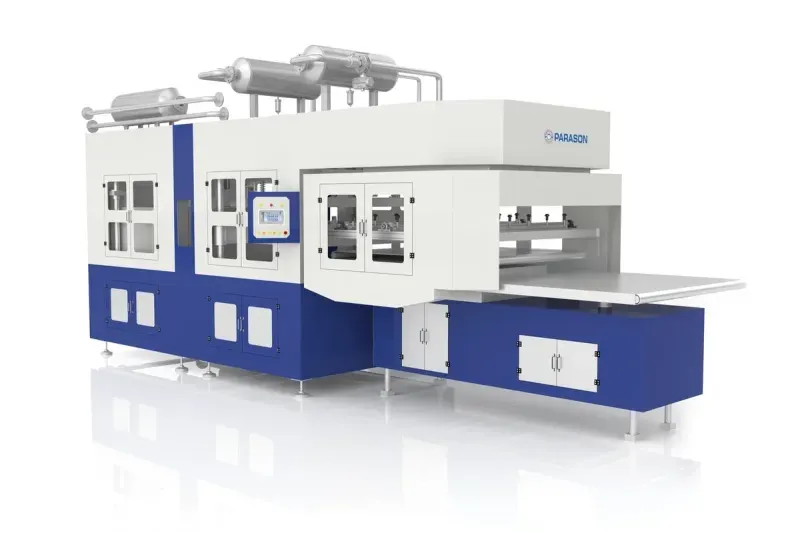
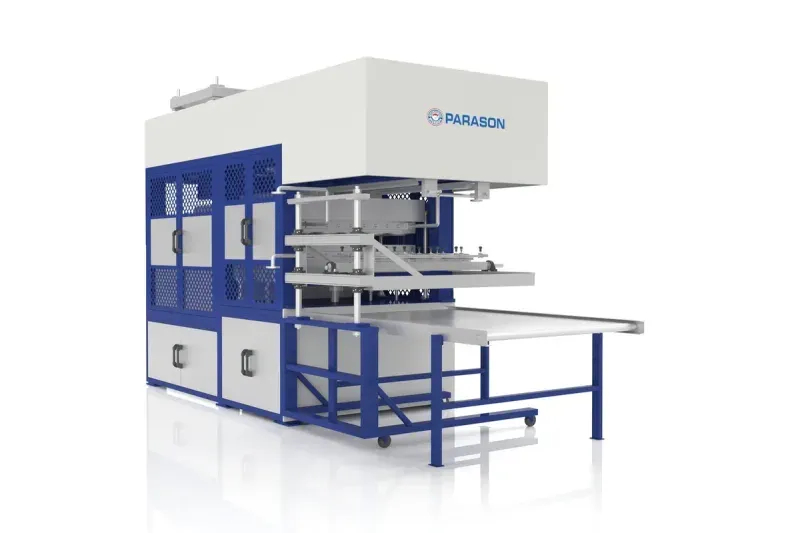
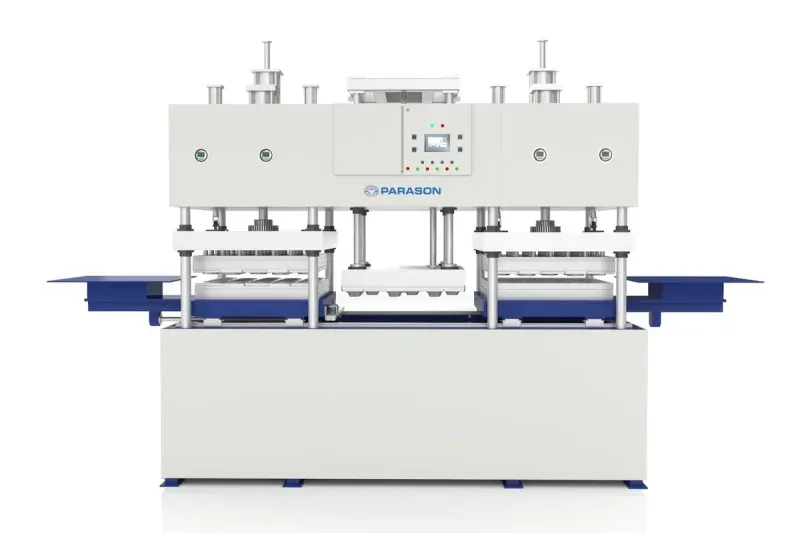
The dual hot press (PFA-D1000) is what you need if your buyers require thermoformed tableware with smooth surfaces on both sides — the kind used for premium food packaging and branded restaurant takeout containers.
See the PFA-S1500 in Action
Parason PFA-S1500 Fully Automatic Forming Machine — live working video at client facility.
Robotic Forming Machine
For fully automated production, the Parason 6-axis robotic forming machine replaces manual pick-and-place operations. The robot handles product transfer from forming to hot press stations with precision — reducing handling rejections and increasing production efficiency. Available in 1100×800 mm and 1000×950 mm platen sizes with advanced reciprocating forming, proximity sensors, limit switches, and safety interlocks. This is the eco friendly disposable plate making machine for operations that need consistent, high-quality output with minimal labor.
Reciprocating Forming Machine
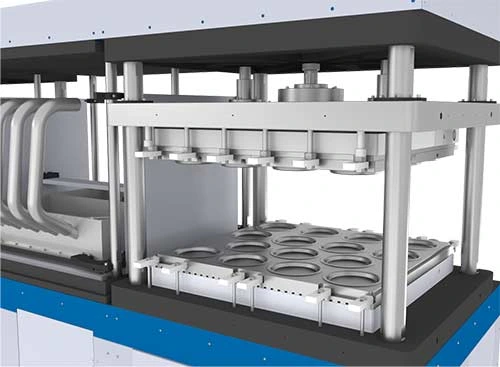
The Parason reciprocating forming machine is designed for products with critical geometry and lesser draft angles. The dipping-type formation system ensures proper deposit of pulp in each forming cycle — essential for biodegradable cutlery making machine applications where complex shapes require uniform wall thickness. Available in 1100×800 mm and 1000×950 mm platen sizes, with 500 kg/day capacity and options for manual or robotic operation.
Semi-Automatic Forming Machine
The most accessible entry point for new investors. Parason’s semi-automatic forming machine features a floating distribution type pulp inlet system that ensures accurate and uniform pouring of pulp onto the mold. Capacity: 500 kg/day. Available in 1100×800 mm and 1000×950 mm platen sizes with PLC and HMI control. Suitable for both manual and robotic operation, with an option to upgrade to fully automatic as your production scales.
Biodegradable Tableware Products You Can Manufacture
A single biodegradable tableware making machine can produce multiple product types by changing the mold. Parason manufactures molds in-house with 25+ VMC machines and offers rapid prototyping for custom designs. Here is what you can produce:
| Category | Products | Typical Applications |
|---|---|---|
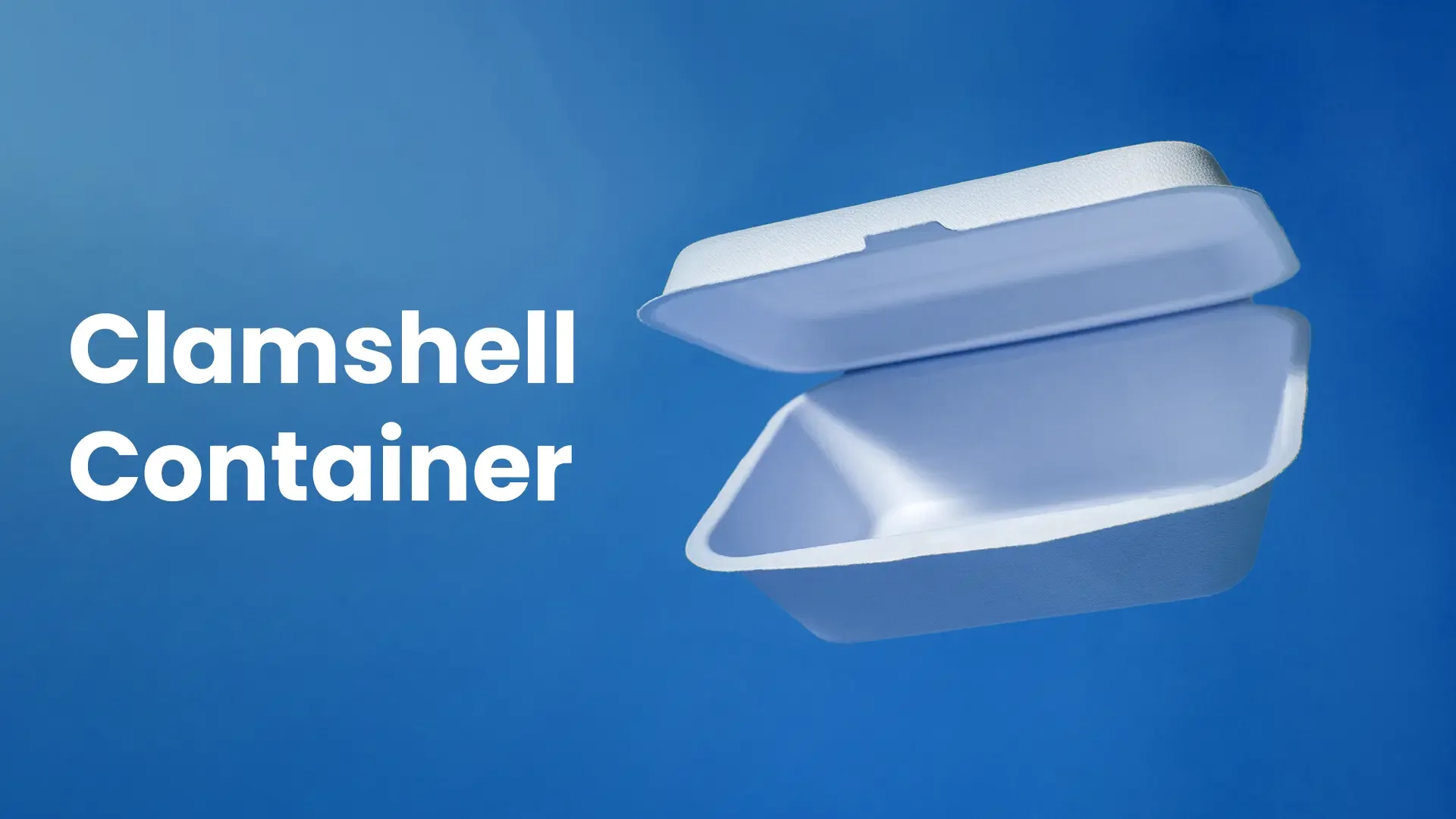
| Tableware | Plates (6″ to12″), bowls, clamshells, meal trays, containers | Restaurants, QSR chains, catering, events |
| Industrial Packaging | Ceiling fan packaging, laptop carrier, modem carrier, faucet carrier | Electronics, appliance, consumer goods |
| Medical | Kit trays, rapid test kit trays, vial trays, kidney trays | Hospitals, diagnostics, pharma |
| Cosmetics | Compact trays, eyeliner palettes, perfume carriers | Beauty brands, retail packaging |
The tableware category alone includes 27 standard product designs with exact dimensions. For custom shapes, our rapid prototyping service takes your design from ideation to production-scale molds: Ideation & Design → 3D Printing & Approval → Prototype Mold Manufacturing → Product Approval → Production Scale Mold Development. We also provide pulp and product trial testing and product certification assistance.
Molded Fiber Types — Which One Do You Need?
Not all biodegradable tableware is the same. The finish quality, thickness, and surface smoothness depend on the molding process. Ask any packaging buyer and they will tell you — the molding type determines whether your product sells at commodity price or premium price:
| Molding Type | Finish | Process | Typical Products | Price Point |
|---|---|---|---|---|
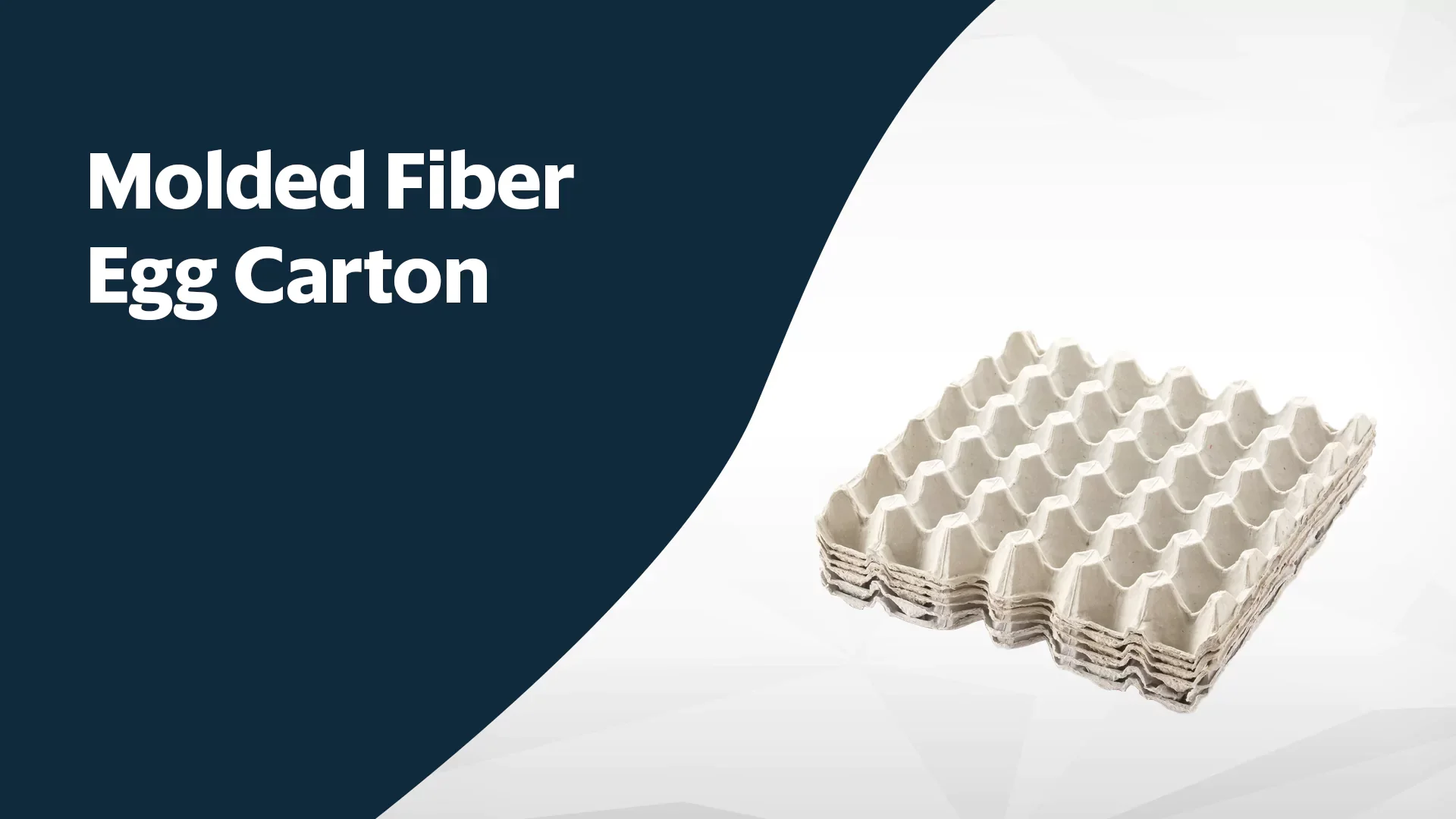
| Thick-Wall | Rough, very thick | Single-mold | Egg trays, fruit trays, industrial packaging | Lowest |
| Transfer Molded | One smooth side, one rough | Two-mold process | Standard plates, bowls, takeout containers | Medium |
| Thermoformed | Very smooth both sides | Multi-stage heated pressing | Premium plates, branded clamshells, retail packaging | Higher |
| Processed | Toasted finish, coated, printed | Post-processing after forming | Custom color products, branded tableware | Highest |
If you are targeting QSR chains or retail food packaging, they require thermoformed or processed tableware — not thick-wall. The PFA-D1000 dual hot press is designed specifically for this segment. For basic egg trays and fruit packaging, thick-wall production with the PFA series gives you efficient volume at a competitive cost per unit.
Raw Materials for Biodegradable Tableware
One of the main advantages of a biodegradable tableware making machine is raw material flexibility. Unlike plastic packaging that requires petroleum-based resin, molded fiber tableware uses agricultural waste that is available in most countries:
| Raw Material | Source | Availability | Best For |
|---|---|---|---|
| Sugarcane Bagasse | Sugar mill by-product | India, Brazil, Africa, Southeast Asia | Most common — excellent fiber for tableware |
| Wheat Straw | Agricultural waste | India, Pakistan, North Africa | Good alternative where bagasse is limited |
| Bamboo | Bamboo plantations | India, China, Vietnam | Premium tableware — strong fiber |
| Hardwood Pulp | Eucalyptus, acacia | Global | High-quality white tableware |
| Softwood Pulp | Pine, spruce | Global | Strength additive for specialty products |
| Recycled Paper | Waste paper, OCC | Global | Lower-grade packaging, egg trays |
In India, sugarcane bagasse is the dominant raw material — sugar mills generate it as a by-product and it is available at low cost. In Africa and Southeast Asia, bagasse and bamboo are both viable. The agriculture waste plate making machine concept works because the raw material is literally what other industries throw away. Your stock preparation system is configured based on which raw material you use — bagasse requires different pulping than bamboo or hardwood.
Stock Preparation for Biodegradable Tableware
The stock preparation system converts raw fiber into the slurry that feeds your forming machine. Get this stage wrong and your formed products will have weak walls, uneven thickness, or contamination specks. For biodegradable tableware, the stock preparation line typically includes:
- Pulper — HICON™ HC Pulper (HM Series, 8 to 220 TPD) for defibering raw material at 14 to18% consistency
- Cleaner — Hi-Density Cleaner to remove sand, dirt, and heavy contaminants
- Screen — Fine screen to remove remaining debris and ensure uniform fiber distribution
- Refiner — Disc refiner to develop fiber bonding strength for structural integrity of formed products
- Consistency regulator — Controls slurry concentration before feeding to forming machine
The stock preparation capacity must match your forming machine output. A PFA-S1500 producing 700 to850 kg/day needs significantly more pulp than a semi-automatic machine producing 500 kg/day. We size the stock prep system based on your actual forming machine selection and target products.
Watch: Pulping & Molded Fiber Systems at Greenko
Advanced pulping and molded fiber systems at Greenko — a turnkey project by Parason showing complete stock preparation and forming line.
Biodegradable Disposable Tableware Manufacturing Plant — Capacity Options
Parason builds complete biodegradable disposable tableware manufacturing plants from 3 TPD to 100+ TPD — turnkey from stock preparation to packaging:
| Plant Size | Daily Output | Forming Machine | Typical Buyer |
|---|---|---|---|
| Small (3 to 10 TPD) | 500 to1,500 kg/day | Semi-automatic or Reciprocating | First-time investor, local market supply |
| Medium (10 to 30 TPD) | 1,500 to5,000 kg/day | PFA-S1300 or PFA-S1500 | Regional supply, single product line |
| Large (30 to 60 TPD) | 5,000 to15,000 kg/day | Multiple PFA machines + robotic forming | Multi-product, national distribution |
| Industrial (60 to100+ TPD) | 15,000+ kg/day | Multiple PFA lines with robotic automation | QSR chain supply, export, contract manufacturing |
A biodegradable disposable plate making machine setup at the 3 to 10 TPD scale is the most accessible entry point. For first-time investors in India and Africa, this keeps capital investment manageable while you build your market and refine your product line. Expansion is straightforward — add another forming machine and increase stock preparation capacity.
Where Parason Supplies Biodegradable Tableware Machinery
The demand for biodegradable tableware and molded fiber packaging is growing fastest in countries enforcing single-use plastic bans — India, UAE, several African nations, and the EU. Parason supplies complete molded fiber production lines to these markets, with raw material sourcing matched to what is locally available:
| Region | Key Markets | Raw Material Available | Applications |
|---|---|---|---|
| South Asia | India, Bangladesh, Pakistan | Sugarcane bagasse, wheat straw | Tableware, food packaging, egg trays |
| Africa | Nigeria, Kenya, South Africa, Egypt | Bagasse, bamboo | Tableware (plastic ban driven), industrial packaging |
| Southeast Asia | Indonesia, Vietnam, Philippines | Bagasse, bamboo, rice straw | Food packaging, export tableware |
| Middle East | UAE, Saudi Arabia | Imported bagasse/pulp | Premium tableware (plastic ban enforced in UAE) |
| Latin America | Brazil, Mexico | Bagasse (Brazil is world’s largest sugarcane producer) | Tableware, QSR packaging |
| North America | USA, Canada | Imported bagasse, bamboo pulp | Compostable food packaging, retail tableware |
Each region has different raw material availability and different product requirements. In India, bagasse is cheap and abundant — ideal for high-volume disposable tableware. In the UAE, buyers demand premium thermoformed tableware for restaurant chains. In Africa, the plastic ban creates immediate market demand but raw material supply chains need to be built. Our project engineers configure the stock preparation and forming systems based on your specific market and raw material — not a one-size-fits-all setup.
With offices in India (HQ + 10+ manufacturing facilities), Brazil (São Paulo manufacturing unit), USA (Surprise, Arizona), UK (London), and UAE (Sharjah), Parason provides local project coordination, installation supervision, and after-sales support in your timezone. Molded fiber installations include Satia Industries India (7 TPD), Skyang Products India (8 TPD), and Kibos Sugar Kenya (6 TPD).
Cost Factors for a Biodegradable Tableware Making Machine
The cost of a biodegradable tableware making machine depends on these factors. Parason does not publish fixed pricing because every project is configured to your specific product, capacity, and raw material:
- Forming machine type — Semi-automatic is lowest cost. Reciprocating with robotic operation is mid-range. PFA automatic series is highest but also highest output per unit cost.
- Capacity — A semi-automatic machine (500 kg/day) costs significantly less than a PFA-S1500 (700 to850 kg/day) setup.
- Stock preparation scope — Depends on raw material. Bagasse requires depithing + pulping. Recycled paper needs less processing.
- Drying system — Hot press drying (included in PFA series) vs tunnel dryer (for thick-wall products) — different cost.
- Molds — Standard mold designs cost less than custom designs. 25+ VMC machines for in-house mold manufacturing.
- Turnkey vs equipment-only — Turnkey includes engineering, installation, commissioning, and training.
Why Parason for Biodegradable Tableware Machinery
Complete system manufacturer — Most biodegradable tableware machine manufacturers sell only the forming machine. Parason supplies the entire production line: stock preparation, forming, drying, trimming, and molds — all designed and manufactured in-house. This means one supplier, one engineering team, one point of accountability.
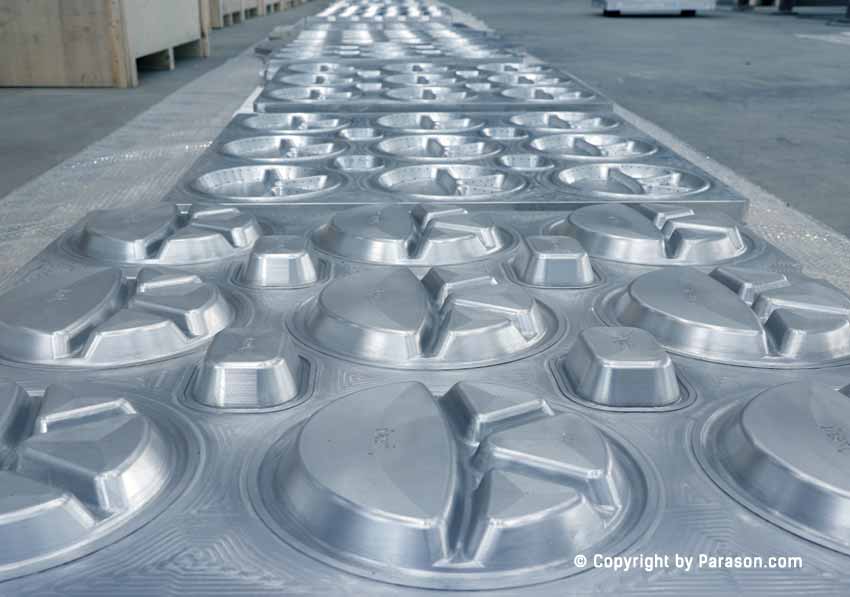
In-house mold manufacturing — 25+ VMC machines dedicated to mold production. Anti-leak mold technology. Custom mold development with rapid prototyping — from concept to production mold. This is something standalone machine sellers cannot offer because they source molds from third parties.
Molded fiber expertise — From our 2,000+ equipment installations across 75+ countries, we have supplied molded fiber production lines to Satia Industries (7 TPD), Skyang Products (8 TPD), and Kibos Sugar Kenya (6 TPD). We understand the full system — not just the forming machine.
Global presence — Offices in India (HQ + 10+ manufacturing facilities), Brazil (São Paulo), USA (Surprise, Arizona), UK (London), and UAE (Sharjah). ISO 9001:2015 certified. Automation partner: ABB.
Whether your project is in India, Nigeria, Bangladesh, Indonesia, or Brazil, Parason delivers the complete biodegradable tableware production line from concept to commissioning.
What Our Clients Say
“The plant has been operating successfully since its commissioning, with consistent and satisfactory production output. The equipment performance has met our expectations in terms of quality, reliability, and operational efficiency.”
“The project was delivered on time and within budget. Parason’s technical expertise, professionalism, and dedication throughout the project have been truly commendable. The seamless integration of equipment and efficient project management played a crucial role.”
“Stock preparation system and forming machines are running satisfactorily. We are planning for expansion with Parason Semi-automatic Forming machines in the coming time.”
Hear From Our Client: KompoPack
Mr. Chirag Jariwala, Managing Director of KompoPack, shares their journey of partnering with Parason for sustainable tableware manufacturing.