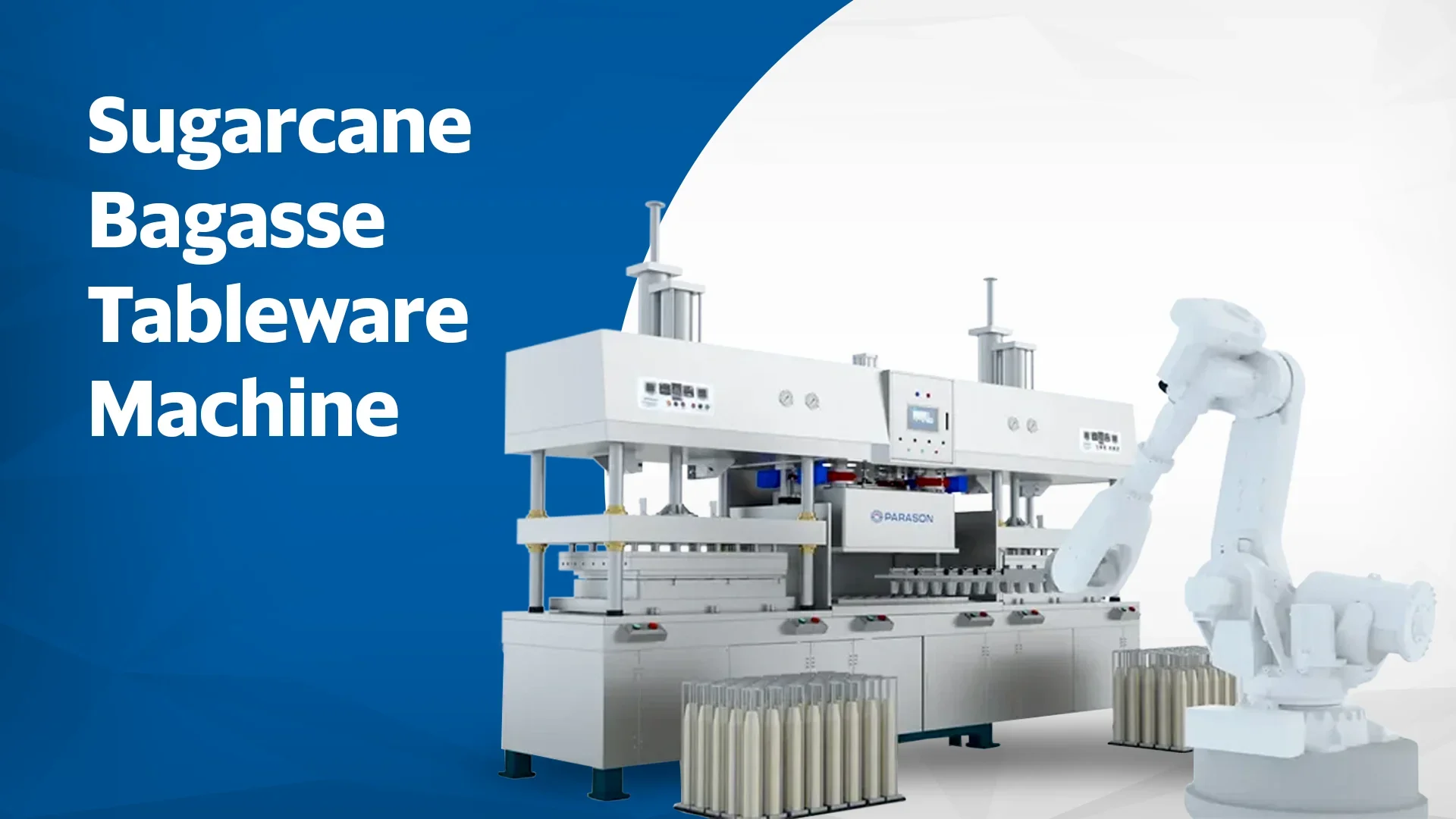
A bagasse tableware machine is forming and pressing equipment that converts sugarcane bagasse pulp into compostable plates, bowls, cups, clamshells, meal trays and containers. In production, the term refers to the complete line: pulper, cleaners, screens, refiner, forming machine, hot press and edge trimmer. This guide covers what the machine does, what it can produce, the main machine types and capacities, the certifications your output must achieve, and how to evaluate a bagasse tableware machine manufacturer before signing.
Parason has supplied bagasse tableware machinery and complete molded fibre lines to brand owners, contract manufacturers and sugar mill diversification projects across 75+ countries since 1976. All machine specifications below come from the Parason Molded Fiber catalog with verified model numbers and capacities.
What is a bagasse tableware machine?
A bagasse tableware machine forms wet sugarcane bagasse pulp into tableware shapes using heated moulds under vacuum and pressure. The dewatered, hot-pressed product is trimmed to final dimensions. It is the same molded fibre forming process used for industrial packaging and medical trays, applied to food service tableware.
A bagasse tableware machine is not a single unit. In production, "the machine" almost always refers to the complete forming and processing line:
- Pulper (breaks bagasse pulp board or wet pulp into slurry)
- Cleaners and screens (remove sand, fibre clumps, fines)
- Refiner (controls fibre length and bonding strength)
- Stock chest with consistency control
- Forming machine (vacuum-formed wet preform on heated moulds)
- Hot press (cures and dries the formed product)
- Edge trimming machine (final dimensional finish)
- Inspection and packaging
The forming machine itself is the centrepiece, but a quote that covers only the forming stage will leave your factory dependent on three or four separate vendors for the rest of the line. Single-source line responsibility is one of the criteria covered in the sourcing section below.
What products can a bagasse tableware machine make?
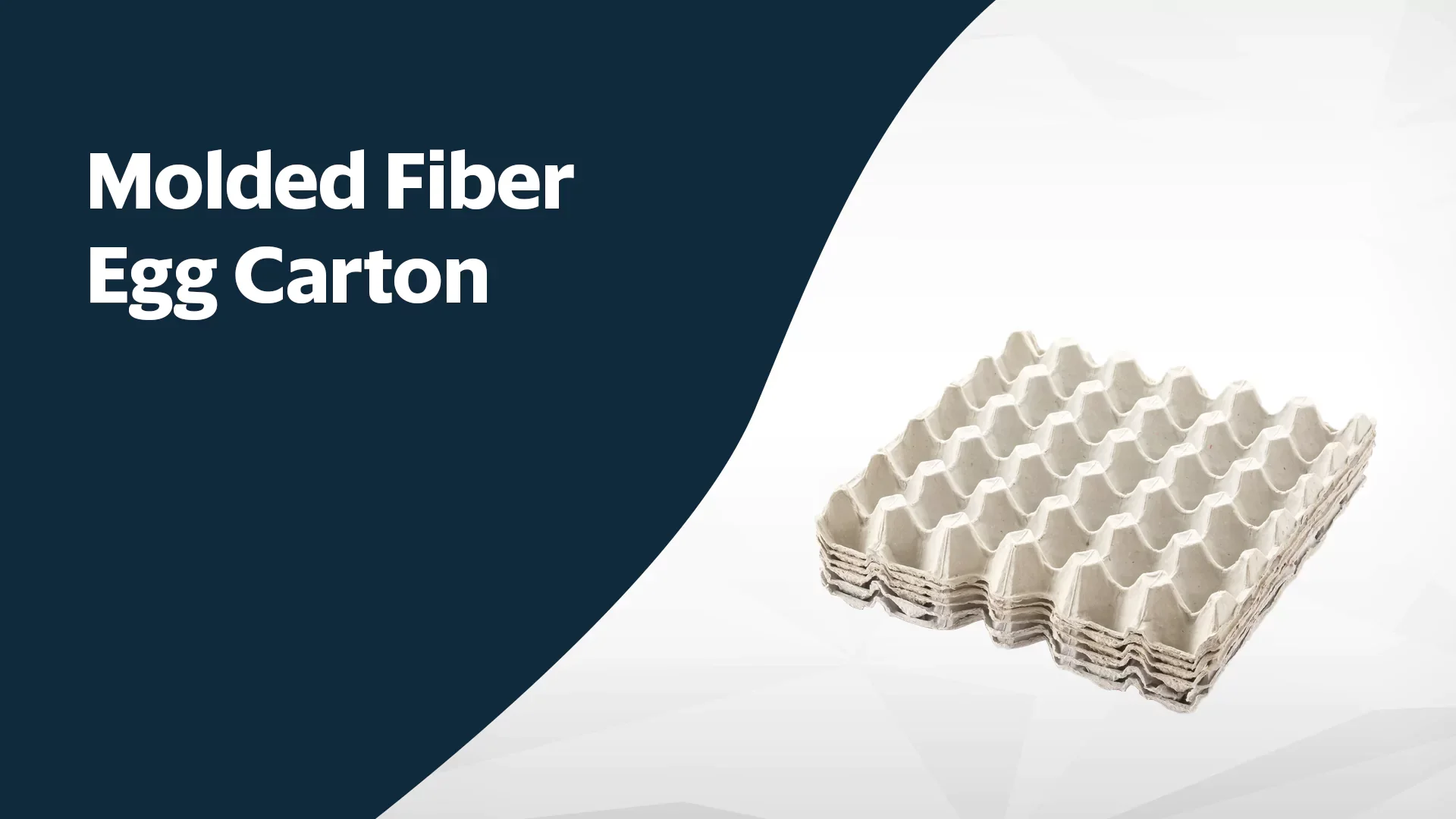
A single bagasse tableware machine, with the right mould set, can produce the full range of compostable food service items: plates, bowls, clamshells, meal trays, containers and cups. Mould interchangeability is what makes the equipment multi-SKU rather than single-product. Cutlery is typically produced on a separate dedicated machine.
| Product Category | Typical SKUs | Mould Notes |
|---|---|---|
| Plates | Round (6", 7", 9", 10", 12"), oval, square, compartment plates, party plates | Shallow draw, high throughput, standard mould complexity |
| Bowls | Soup bowls, salad bowls, dessert bowls, noodle bowls, ice cream bowls | Medium draw, requires bowl-specific moulds |
| Clamshells | Burger clamshells, sandwich clamshells, 1- and 3-compartment lunch boxes | Two-piece mould with hinged geometry |
| Meal trays | Airline trays, school meal trays, hospital trays, ready-meal trays | Multi-compartment moulds, deeper geometry |
| Containers | Round food bowls with lids, takeaway boxes, deli containers, soup cups | Deeper draw moulds, often paired with lid moulds |
| Cups | Cold-drink cups, ice-cream cups, dessert cups, condiment cups | Deeper draw, longer cycle time per piece |
| Cutlery | Spoons, forks, knives, stirrers | Usually produced on dedicated cutlery machines, not tableware forming lines |
| Specialty | Egg cartons, fruit trays, wine bottle trays, branded retail tableware | Custom mould design, often thicker-wall |
Parason's tableware product library covers 27 documented configurations across plates, bowls, clamshells, meal trays and containers, with verified mould geometries (Parason Molded Fiber catalog, Section 14). Custom SKUs are developed through the R&D lab using prototype moulds before production-scale tooling is committed.
Important note on cutlery. Bagasse spoons, forks and knives are usually produced on dedicated cutlery machines rather than the tableware forming line. If cutlery is part of your business plan, plan for a separate machine or a cutlery-specific OEM partner.
How does a bagasse tableware machine work?
A bagasse tableware machine works in four physical stages: pulping, forming, hot pressing and trimming. Each stage runs continuously in a properly engineered line, with bagasse going in at the pulper end and finished, packaged tableware coming out at the other.
Stage 1: Pulping
Raw bagasse (either as bagasse pulp board or as wet pulp from a co-located sugar mill) is fed into a pulper with water. The pulper breaks the fibre into a uniform slurry at a controlled consistency, typically in the range of 3% to 4% for forming-grade stock.
Stage 2: Stock Preparation
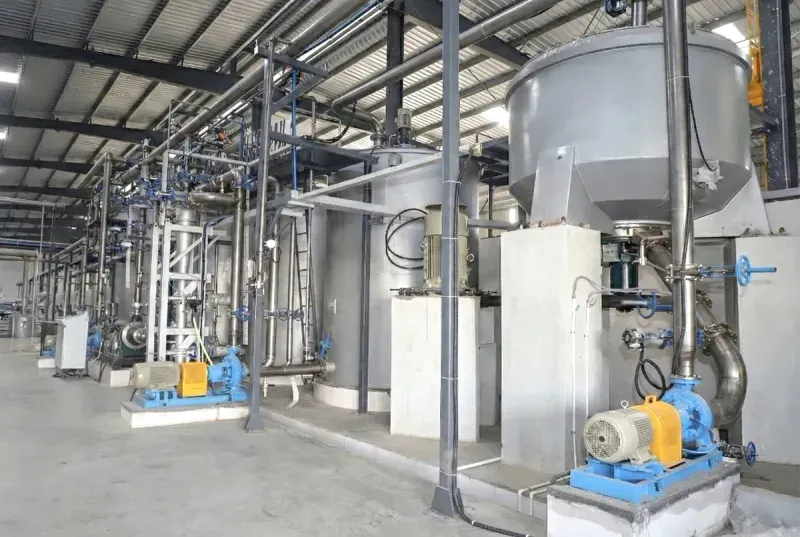
Cleaners remove sand and heavy contaminants. Pressure screens remove fibre clumps and shives. A refiner adjusts fibre length and bonding to the requirement of the product (a paper plate needs different refining than a hot-soup bowl). Consistency is tightened in a stock chest before the slurry reaches the forming machine.
Stage 3: Forming
The forming machine draws pulp slurry onto heated moulds under vacuum. As water is pulled through the mould, fibre deposits build up in the shape of the product. The wet preform is then transferred to the hot press.
Stage 4: Hot Pressing and Trimming
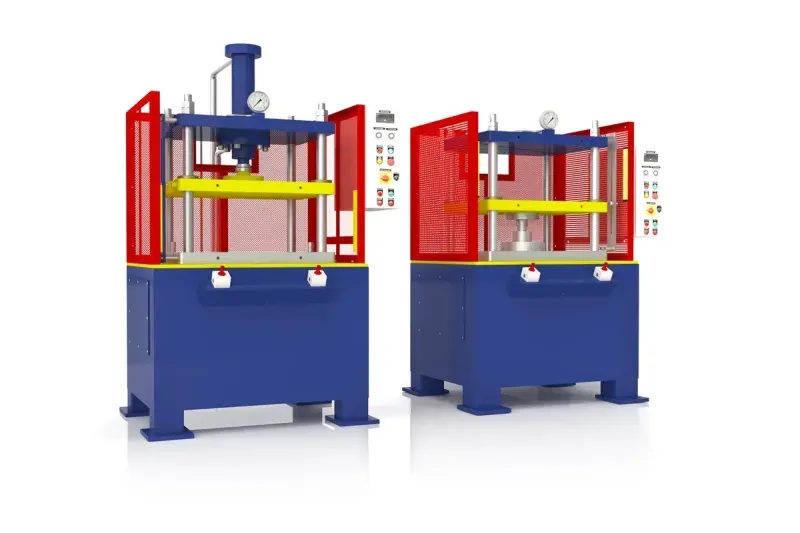
The hot press cures the product, drying the fibre and setting final shape under combined heat and pressure. Edge trimming follows, removing the formed flash to reach final dimension. The finished tableware is inspected, stacked and packed.
For a stage-by-stage technical depth on the equipment that drives each step, see our biodegradable tableware making machine guide, which covers each line component in detail.
Types of bagasse tableware machines: PFA, PRF, PREF, Robotic, Semi-Automatic
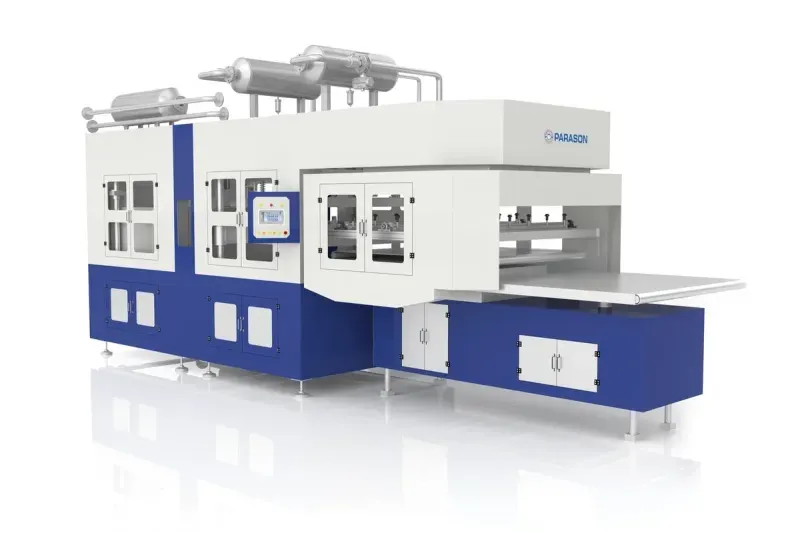
The forming machine type determines throughput, SKU flexibility and product mix. Five main machine families serve the bagasse tableware market: PFA automatic, PRF rotary, PREF reciprocating, Robotic forming and Semi-Automatic.
| Machine Series | Type | Best For | Capacity (Parason catalog, verified) |
|---|---|---|---|
| PFA Series (Automatic Forming) | Hot-press, fixed platen | High-volume plates, bowls, trays in stable SKU mix | PFA-S1500: 700 to 850 kg/day; PFA-S1300: 350 to 500 kg/day; PFA-D1000: 350 to 500 kg/day (dual hot press) |
| PRF Series (Rotary Forming) | Rotary multi-station | Highest throughput on a narrow SKU set | PRF-1: 8,000 pcs/hr; PRF-2: 6,000 pcs/hr; PRF-3: 5,000 pcs/hr; PRF-4: 4,000 pcs/hr; PRF-5: 3,000 pcs/hr |
| PREF Series (Reciprocating) | Reciprocating platen | Multi-SKU production with frequent mould changes | PREF-1: 2,900 pcs/hr; PREF-2: 2,400 pcs/hr; PREF-3: 1,900 pcs/hr; PREF-4: 1,400 pcs/hr; PREF-5: 1,000 pcs/hr |
| Robotic Forming Machine | 6-axis robot-assisted | Premium product, complex geometry, branded retail SKUs | Custom configuration |
| Semi-Automatic | Manual loading, automatic forming | Pilot production, startup capacity | Approximately 500 kg/day |
All capacities above are from the Parason Molded Fiber catalog (Section 14: Forming Machines).
How to read the table:
- If you are launching with 2 or 3 high-volume SKUs (for example, a QSR contract for standard plates and bowls), PRF series offers the highest piece-per-hour output.
- If your business plan calls for 6 to 12 SKUs across plates, bowls, cups, clamshells and containers, PREF series supports faster mould changeover for SKU rotation.
- PFA series sits between the two, ideal for a stable product mix with high daily kilogram output.
- Robotic Forming Machine is suited to premium retail or branded SKUs where finish quality and geometry complexity matter more than throughput.
- Semi-automatic is the entry point for pilot operations or startups, with the line expandable as orders grow.
Bagasse tableware machine capacity: match the machine to your product mix
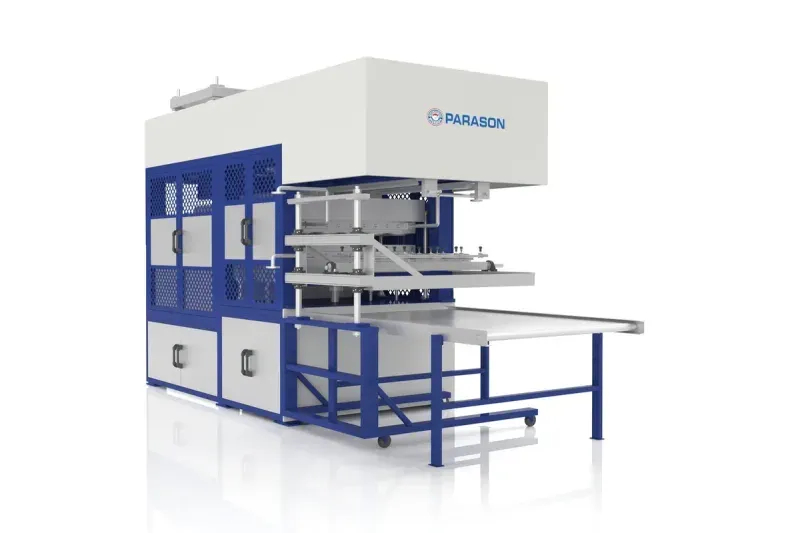
The right capacity depends on three factors: total daily output, SKU mix and mould rotation frequency. Parason supplies complete bagasse tableware lines from 3 TPD up to 100+ TPD. The capacity decision drives every other line component: pulper size, cleaning and screening capacity, refiner duty, dryer length and trimming throughput must all be sized together.
Capacity decision logic:
- Pilot / startup (1 to 3 TPD): Semi-automatic or single PFA-S1300 line. Suitable for market entry, customer sampling and early certification trials.
- Small commercial (5 to 10 TPD): Single PFA-S1500 or PREF series line. Profitable scale with multi-SKU flexibility.
- Mid-scale (10 to 30 TPD): Multi-line setup combining PFA and PREF, or a single PRF series line for high-volume SKUs. Common scale for an export-focused brand.
- Large industrial (30 to 100+ TPD): Multiple PRF or PFA lines in parallel, often integrated with an on-site sugar mill for direct bagasse supply.
Compostability and food contact: certifications your machine output must achieve
A bagasse tableware machine does not certify itself. The product the machine produces must pass certifications relevant to your sales market: ASTM D6400, EN 13432, BPI, FDA, EU 10/2011 and BIS. These determine which buyers will accept your output and which markets you can sell into.
| Standard | Region | What It Tests | Required For |
|---|---|---|---|
| ASTM D6400 | North America | Industrial compostability: ≥90% biodegradation in 180 days, disintegration in 84 days | U.S. compostable claim, BPI certification |
| EN 13432 | European Union, UAE Phase 2 | Industrial compostability: disintegration in 12 weeks, full biodegradation in 6 months | EU compostable claim, UAE 2026 ban compliance |
| BPI Certification | North America | Audited certification using ASTM D6400 as base standard | Acceptance at most U.S. commercial composting facilities; California legal "compostable" use |
| FDA Food Contact | Global export reference | Migration limits, additive safety | U.S. food service customers |
| EU Regulation 10/2011 | European Union | Food contact materials regulation | EU food service customers |
| BIS (Bureau of Indian Standards) | India | Domestic conformity | Sale within India |
Standards confirmed against ASTM International, the European Committee for Standardization (CEN), the Biodegradable Products Institute (BPI), the U.S. FDA and the Bureau of Indian Standards public documents.
Two further checks buyers increasingly demand:
- PFAS-free verification. Some low-cost bagasse tableware suppliers add PFAS-based oil and water repellents. Major U.S. states and EU regulations now require detection thresholds at or below 20 parts per trillion. Ask your machine manufacturer about PFAS-free additive recipes, and ask for the lab method, not just a "PFAS-free" claim on a brochure.
- Lot-level traceability. Lot documentation tracing raw bagasse from sugar mill through pulping, forming and packaging is increasingly audited by buyers in regulated markets (EU, North America, UAE post-2026).
A reliable bagasse tableware machine manufacturer will help you set up production parameters and additive recipes that pass these certifications. Equipment alone does not guarantee certifiable output. Your manufacturer's R&D and process engineering support do.
How to choose a bagasse tableware machine manufacturer: six criteria
Choosing the right manufacturer is the highest-leverage decision in the project. The equipment lasts 20+ years; spare parts, service and SKU expansion happen across that horizon. Verify six criteria before you shortlist any supplier: in-house manufacturing depth, full line scope, mould flexibility, regional service, customer references and R&D support.
1. In-house manufacturing depth
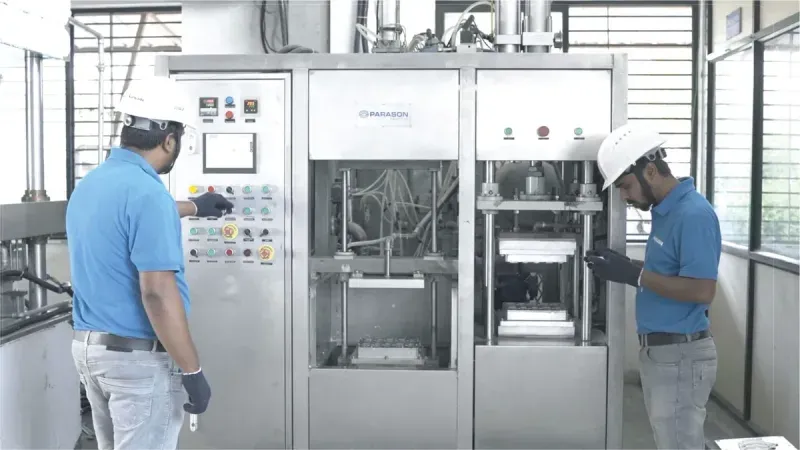
A real bagasse tableware machine manufacturer designs its own forming machines, machines its own moulds and runs its own engineering R&D. A trader buys generic OEM machines and applies branding. The difference shows up two years later, when a critical part fails and the trader cannot supply a replacement.
What to verify:
- Foundry and machine shop on the manufacturer's premises (request a factory tour)
- Number of VMC (vertical machining centre) machines used for mould production
- In-house metallurgy and heat treatment capability for forming dies
- Engineering team size and tenure (not just sales staff)
- Whether they can show you a forming machine being built on the shop floor
For reference, Parason operates 25+ VMC machines dedicated to mould manufacturing and runs a specialised SS foundry with metallurgical and heat-treatment expertise (per Parason engineering specifications). That is the depth required to produce anti-leak moulds at scale.
2. Full production line scope, not just forming
A bagasse tableware machine is one component of a larger production line. A manufacturer that sells only the forming machine leaves you stitching together pulping, stock preparation, drying and finishing from three different vendors, each blaming the others when output quality drops.
Ask your prospective manufacturer to provide:
- A complete process flow diagram from raw bagasse to finished tableware
- The equipment list at each stage with model numbers
- Performance guarantees on the complete line, not only per machine
- Single-source accountability for line commissioning
3. Mould flexibility for multi-SKU production
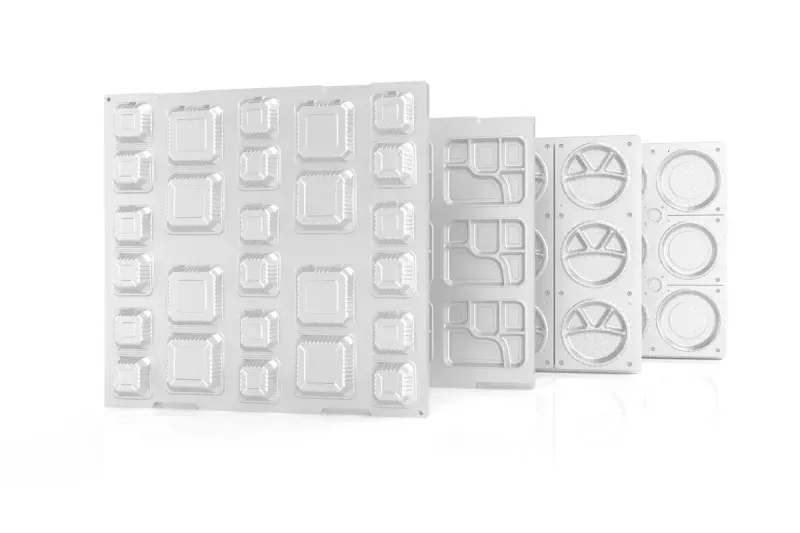
Bagasse tableware is a multi-SKU business. A new factory typically launches with 6 to 12 product types: round plates in 2 or 3 sizes, oval plates, bowls in 2 sizes, clamshells, meal trays, square containers. Demand shifts every year. Your factory's profitability depends on how fast you can add new SKUs.
Mould-flexibility questions:
- Are moulds designed in-house or outsourced?
- What is the lead time for a new mould, from design approval to production?
- Is the forming machine designed for fast mould changeover, or is each change a multi-day operation?
- Can the manufacturer prototype and test a new product before committing to production tooling?
- Do they offer rapid prototyping (3D printed prototypes, sampling trials, certification assistance)?
A manufacturer that quotes a six-month lead time for a new mould is selling you a single-SKU factory, regardless of how the brochure reads.
4. After-sales service footprint in your region
The forming machine is sold once. Spare parts and service calls happen for the next 20 years. If your manufacturer's nearest service engineer is on another continent, your downtime cost will exceed the equipment price within a few years.
Verify before signing:
- Service engineer presence in your country or region. Ask for names and contact details, not a "regional partner" promise.
- Spare parts inventory locations. Critical wear parts (forming dies, hot press elements, vacuum pumps) need to be reachable within days, not weeks.
- Warranty terms in writing, with clear coverage of defect vs. wear vs. operator error.
- Operator training scope. Two days of training is not enough. Proper handover involves 2 to 4 weeks of on-site commissioning plus follow-up visits.
5. Verifiable customer references (operating plants)
A reference list on a brochure means nothing. Operating plants you can visit (or video-call) mean everything. Ask for three references in similar capacity range, ideally in your geography or one with comparable infrastructure.
Questions to ask the reference customer:
- How long from order placement to first saleable product?
- Did the line deliver the contracted capacity, or did it underperform?
- What was the after-sales response time in the first year?
- Would they buy from the same manufacturer again? (Listen for the pause before the answer.)
- What surprised them about the project that they wish they had known earlier?
6. Engineering R&D and certification support
Compostability and food-contact certifications are not optional anymore. Buyers ask for them at every RFQ. If your equipment manufacturer's process cannot reliably produce certifiable product, your factory will fail audits.
Certification support to require:
- In-house R&D lab with pilot-scale forming machines for trials
- Ability to produce certification-grade samples from your raw material
- Documentation of past customer certifications (ASTM D6400, EN 13432, BPI, FDA, EU 10/2011, BIS)
- Recipe development for your specific raw material (bagasse alone, bagasse with wheat straw, bagasse with bamboo)
Bagasse tableware machine in India, UAE and global markets
Bagasse tableware machines are sourced primarily from India, China and (to a smaller extent) Southeast Asia. Each region has distinct strengths and trade-offs. India offers raw material proximity and BIS-compliant manufacturing, China offers entry-level pricing, and the UAE and Middle East are a fast-growing import market after Phase 2 of the single-use plastic ban.
India
India is the world's second-largest sugar producer (Indian Sugar Mills Association, 2024), with abundant bagasse supply and a mature molded fibre engineering base. The Indian Paper Manufacturers Association (IPMA) documents deep capability in molded fibre forming, refining and stock preparation. Indian-built bagasse tableware machinery typically combines competitive pricing with English-language documentation and engineering support familiar to international buyers.
Strengths: Raw material proximity, mature pulping engineering, BIS-compliant manufacturing, export experience, competitive cost.
Trade-offs: Capacity with established manufacturers is often booked 4 to 6 months ahead, so plan timelines accordingly.
China
China has the largest installed base of bagasse tableware forming machines globally. Pricing on entry-level machines is the most aggressive in the market.
Strengths: Short lead time on stock models, large supplier pool, low entry-level pricing.
Trade-offs: Wide quality variance between suppliers. Many sellers on B2B platforms are traders, not manufacturers. Spare parts logistics into Africa, Middle East and parts of South America add significant lead time. Documentation, after-sales service and certification support quality vary widely. Factory ownership verification is essential.
UAE and Middle East
The UAE does not have a large in-country equipment manufacturing base for bagasse tableware. Equipment is sourced from India, China or Europe and shipped in. With the UAE single-use plastic ban Phase 2 effective 1 January 2026 covering cutlery, cups, plates and food containers, in-country demand for bagasse tableware machines installed locally is rising sharply. Indian and Chinese suppliers compete heavily for these projects.
Southeast Asia (Vietnam, Indonesia, Malaysia)
Smaller equipment manufacturing base. Most regional buyers in Indonesia and Vietnam source equipment from India or China. Strong local demand for finished bagasse tableware (driven by tourism and hospitality export markets), but limited equipment-side supplier depth.
Why the bagasse tableware equipment market matters in 2026
The Indian biodegradable tableware market is projected to reach USD 1,935.8 million by 2030 at a 9.3% CAGR (Grand View Research), driven by India's 2022 single-use plastic ban and the UAE's Phase 2 ban effective 1 January 2026. The combined India biodegradable tableware and packaging products market is forecast to reach USD 3.23 billion by 2030.
The Indian biodegradable tableware market is projected to reach USD 1,935.8 million by 2030 at a CAGR of 9.3% (Grand View Research), with plates and trays as the largest revenue segment and cutlery as the fastest-growing category. The combined India biodegradable tableware and packaging products market is forecast to reach USD 3.23 billion by 2030 (Grand View Research). The India biodegradable food service disposables sub-segment is forecast by IMARC Group to grow from USD 53.7 million in 2024 to USD 88.0 million by 2033.
What is driving demand is regulation. India banned identified single-use plastic items effective 1 July 2022 (Press Information Bureau, Ministry of Environment notification 12 August 2021), covering plates, cups, cutlery, straws and food containers. The United Arab Emirates implemented Phase 1 of its single-use plastic ban on 1 January 2024 and Phase 2 (covering plastic cutlery, cups, lids, plates and food containers) on 1 January 2026 (UAE Ministry of Climate Change and Environment). Similar bans are in force or pending across the European Union, Indonesia, Vietnam and several U.S. states.
For a factory starting production in 2026, the demand curve is no longer speculative. The implication is that your machine manufacturer choice affects whether you reach buyers (food service brands, retail chains, exporters) who require certifications and traceability that only properly engineered production lines can deliver.
Common mistakes when buying a bagasse tableware machine
Seven recurring mistakes show up across pre-sales evaluations: quote-shopping without spec alignment, skipping factory visits, ignoring spare parts logistics, underestimating mould lead times, trusting unverified compostable claims, treating training as an afterthought, and not asking about R&D pilot capability.
- Quote-shopping without specification alignment. Comparing a PFA-S1300 quote from one supplier to a generic "350 kg/day" quote from another is comparing different products. Force every quote to address the same specification sheet.
- Skipping the factory visit. A virtual tour is not a substitute. The first time you walk a manufacturer's shop floor, the conversation about quality changes permanently.
- Ignoring spare parts supply chain. A forming die is a wear part. If your manufacturer cannot deliver replacements to your location in under three weeks, your factory will have unplanned downtime in year one.
- Underestimating mould lead times. New SKU launches require new moulds. If your business plan assumes monthly SKU rotation but your manufacturer needs four months per mould, the plan does not work.
- Trusting "compostable" labels without certificates. Always ask for the actual ASTM D6400, EN 13432 or BPI certificate document, not a brochure claim. Verify the certificate against the issuing body's online registry.
- Treating training as an afterthought. A new operator team needs 2 to 4 weeks of supervised commissioning, not a 2-day workshop. Negotiate this into the contract before signing.
- Not asking about R&D pilot capability. Your bagasse will not be exactly the same as the reference customer's bagasse. If the manufacturer cannot run a pilot trial with your raw material, you are buying blind.
Why Parason as your bagasse tableware machine manufacturer
Parason has supplied molded fibre and paper machinery to 2,000+ installations across 75+ countries since 1976. For an equipment buyer evaluating bagasse tableware machinery, the credentials that matter are in-house manufacturing depth, full forming machine range, mould design and rapid prototyping, stock preparation expertise, operating customer references, tableware-specific product depth, an R&D lab and certification support.
- Complete in-house manufacturing. Specialised SS foundry, 25+ VMC machines for mould production, in-house heat treatment, and metallurgical lab.
- Full forming machine range. PFA, PRF, PREF, Robotic and Semi-Automatic options covering 350 kg/day to 100+ TPD capacity (Parason Molded Fiber catalog, Section 14).
- In-house mould design and rapid prototyping. 3D-printed prototypes, sampling trials, certification-grade product runs and production-scale mould development.
- Stock preparation expertise. Complete pulping, cleaning, screening, refining and approach flow systems built in-house, not outsourced.
- Operating customer plants for site visits. Examples: Skyang Products LLP (8 TPD bagasse tableware line, India); Satia Industries (7 TPD molded fibre line, India); Kibos Sugar & Allied (6 TPD molded fibre line, Kenya). Verifiable by visit or video call.
- Tableware-specific product depth. 27 documented tableware product configurations including plates, bowls, clamshells, meal trays and containers, with verified mould geometries.
- R&D Lab. Advanced molded fibre pilot plant with full stock preparation setup for real-condition mould testing.
- Certification support. Documented past customer certifications across ASTM, EN, BPI, FDA and BIS standards.
Client appreciation (verified text quotes, with client permission):
"Parason delivered our molded fibre line on schedule and supported us through the certification process. Their engineering team understood our SKU mix and adjusted the line accordingly."
Kagathara Group / Goldleaf Pulp Tableware
"What stood out was the depth of after-sales support during the first six months of operation. Issues that would normally have caused weeks of downtime were resolved within days."
Greenko Industries / Nature Dine
"We evaluated suppliers across India and China before choosing Parason. The deciding factor was their in-house mould manufacturing, which gave us confidence on new SKU rollout timelines."
Carma Industries
Ready to discuss your bagasse tableware machine requirements?
The fastest way to evaluate a bagasse tableware machine manufacturer is the way we recommend evaluating every supplier: a structured conversation about your product mix and capacity, a process flow walkthrough, a reference customer introduction, and a site visit to our Aurangabad facility. Reach out and we will arrange all four within two weeks.